Лексика Ботании в майнкрафте
Технические характеристики 

Описание и особенности
Лексика, добавляемая модом Ботания майнкрафт, содержит подробное описание всех элементов мода, что непременно поможет вам, чтобы понять все особенности создаваемого элемента, только учтите, что с самого начала, когда вы откроете эту книгу вы увидите далеко не все.
Итак, давайте начнем с крафта Лексики, который представляет из себя следующее:
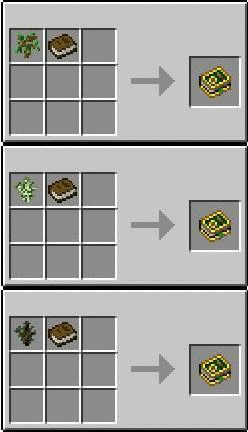
То есть для создания вам понадобится:
В книге есть специальная разбивка по разделам, которая поможет находить необходимое, также есть возможность сделать специальные закладки, которые при нажатии на них будут возвращать в нужное место в книге и это очень удобно, так как в ней написано действительно очень много.
Если у вас есть Лексикон Ботании, а также что-нибудь из данного мода находится у Вас в инвентаре, то наведя на эту вещь курсор мыши вы увидите подсказку нажать на клавишу CTRl (контрл) и если вы нажмете и подержите ее пару секунд, то в итоге у вас в руках окажется Лексикон, который откроется на странице описания этого предмета.
Чтобы дополнить книгу знаниями эльфийского народа вам надо будет построить портал в Эльфхеим, активировать его и после этого закинуть эльфам на другой стороне, после чего они вам взамен выкинут более полную версию, дополнив ее своими знаниями и ваши возможности увеличатся значительно, все знания, которые будут относиться к эльфам будут написаны зеленым цветом — это также поможет вам ориентироваться.
Также, по мере того, как вы будете убивать Стражей, вызываемых с помощью ритуала Гайи 2 и получать реликты — книга также будет дополняться записями по выбитым со Стража артефактам и вы сможете узнать о них более подробно и в чем заключается их особенность.
Как улучшить лексику ботании
Лексика, добавляемая модом Ботания майнкрафт, содержит подробное описание всех элементов мода, что непременно поможет вам, чтобы понять все особенности создаваемого элемента, только учтите, что с самого начала, когда вы откроете эту книгу вы увидите далеко не все.
Итак, давайте начнем с крафта Лексики, который представляет из себя следующее:

То есть для создания вам понадобится:
В книге есть специальная разбивка по разделам, которая поможет находить необходимое, также есть возможность сделать специальные закладки, которые при нажатии на них будут возвращать в нужное место в книге и это очень удобно, так как в ней написано действительно очень много.
Если у вас есть Лексикон Ботании, а также что-нибудь из данного мода находится у Вас в инвентаре, то наведя на эту вещь курсор мыши вы увидите подсказку нажать на клавишу CTRl (контрл) и если вы нажмете и подержите ее пару секунд, то в итоге у вас в руках окажется Лексикон, который откроется на странице описания этого предмета.
Чтобы дополнить книгу знаниями эльфийского народа вам надо будет построить портал в Эльфхеим, активировать его и после этого закинуть эльфам на другой стороне, после чего они вам взамен выкинут более полную версию, дополнив ее своими знаниями и ваши возможности увеличатся значительно, все знания, которые будут относиться к эльфам будут написаны зеленым цветом — это также поможет вам ориентироваться.
Также, по мере того, как вы будете убивать Стражей, вызываемых с помощью ритуала Гайи 2 и получать реликты — книга также будет дополняться записями по выбитым со Стража артефактам и вы сможете узнать о них более подробно и в чем заключается их особенность.
Тема: botania
Опции темы
Поиск по теме
Отображение

botania
для начала нам потребуется та самая книга, она чем-то напоминает таумономикон, но выполняет только функцию описания предметов и показа их рецептов. создается она довольно просто если вы нашли деревню и библиотеку, так как делать её вам нужно из книги и ростка любого саженца.
после чего вы разобрались с книгой вам необходимо заняться поисков мистических цветов из данного мода, отличить их можно по тому что они выпускают из себя сверкающие частицы, их 16 видов и все они отличаются цветами, их можно вырастить используя на земле костную муку и выглядят они так, тут они показаны в их порядке в моде, от белого до черного :
список всех лепестков которые существуют в ботании
мистический белый лепесток
мистический сиреневый лепесток
мистический светло синий лепесток
мистический жёлтый лепесток
мистический лаймовый лепесток
мистический розовый лепесток
мистический серый лепесток
мистический светло серый лепесток
мистический бирюзовый лепесток
мистический синий лепесток
мистический коричневый лепесток
мистический зелёный лепесток
мистический красный лепесток
мистический чёрный лепесток
так-же с лепестками можно сделать несколько интересных штук, и для этого нам понадобится измельчить их с помощью ступки и пестика который делается по следующему рецепту.
после получения данного предмета, мы можем приступать к измельчению лепестков в пыльцу, можно класть лепесток любого цвета, на выходе мы получим аналог лепестка в форме пыльцы, то-есть если измельчить красный лепесток, мы получим красную пыльцу и так далее.
все мы знаем насколько важен чай в нашей жизни и особенно в жизни англичан, хотя я люблю кофе но не заметить чай невозможно, вот этот самый чай смог стать важной шишкой ещё в 1 моде, на самом деле все начинается как обычно, но вместо чая выходят цветы, просто из-за схожести я решил его назвать чаем, и для его приготовления нам понадобится скрафтить чайник под названием «лепестковый аптекарь», можно ставить любой вид лепестков, я для примера взял белый.
и если его расположить в мире то он будет выглядеть весьма неплохо, можно его даже на пьедестал поставить.
что-бы вы все очень быстро поняли и что-бы вам в будущем было легко, я разделил процесс на 3 этапа, 2 этапа из 3 во всех рецептах повторяются и никогда не меняются, в итоге вы потом это на автомате делать будете.
1 этап : наполните его водой, пкм по лепестковому аптекарю ведром воды или бросьте туда ведро нажав q
2 этап : нажимая q кидайте туда лепестки и разные блоки в зависимости от рецепта, они там плавают.
3 этап : для завершения бросьте туда семена пшеницы, после чего вам дадут цветок.
про рецепты мы поговорим потом.
так же его можно тюнинговать, не важно есть там вода или нет, просто бросьте туда лозу
кхм! настал час создания первого цветка! и для этого вы должны как я вас обучил исполнить 3 этапа его создания, в первую очередь наполните аптекарь водой а потом киньте туда 4 белых лепестка, после чего суете туда же семена пшеницы и вуаля.
мы создали наш первый цветок!
спустя минуту или около того они поочередно начнут превращение, и вам покажется что их уже можно собрать, но не дайте себя обмануть, ведь это скорее просто иллюзия, нажмите по блоками пкм, и если они обратно превратились в камень/древесину значит процесс ещё не завершен, просто ждите и проверяйте, и если они не превратились обратно, значит процесс завершен, и можно собирать киркой/топором то что у нас получилось, эти блоки будут нашим основным материалом для конструкции.
ботания добавляет свой вид энергии, который называется «мана» и имеет такие же 3 состояния как и вода :
твёрдое
жидкое
газообразное
можно её назвать мочой богов чтоли?
в общем то это ману генерируют специальные растения из категории «создающей флоры».
и первый цветок который будет создавать нам ману полностью копирует принцип работы солнечных панелей, некоторым будет проще понять как работает цветок.
называется он «дневной цветок», и это название он получил не просто так.
лексика ботании предоставляет нам немного информации о том как он создает эту ману.
цветок обладает измененным процессом фотосинтеза, который преобразует солнечный свет в ману, из чего следует вывод что работать он будет только днем, просто поставил и все, только вот цветок генерирует уж больно очень мало маны, но для начала сойдет. так как процесс идет очень медленно, книга советует нам использовать одновременно 10-12 таких цветов, и я с этим соглашусь, первый цветок а все уже так запутанно, ещё ещё один очень большой минус, из-за которого нам придется использовать 200% пространства или проще говоря, нам потребуется в два раза больше пространства, потому-что эти цветы конкурируют за место под солнцем так, что любой прилегающий к одной из четырех его сторон цветок будет терять эффективность производства маны так же как и он сам, мало того что цветок генерирует меньше маны чем вода что капает с водопроводного крана, так он ещё и может потерять эффективность, этим цветком далеко не зайдешь, но для начала он идеален, крафт :
2 мистических желтых лепестка
1 мистический светло-синий лепесток
1 мистический оранжевый лепесток
имеет 2 подписи :
«тень дня»
«призрачная подпись»
настало сделать один из важнейших инструментов, с которым вы вряд ли расстаньтесь.
называется он посохом леса, он сделает с помощью прививания пары лепестков к веткам жизнедерева, и нужен он почти во всех аспектах мода, цвет лепестком не имеет значения, но от цвета лепестков зависит и цвет лепестков на самом посохе, можно так различать свой посох от чужого. для примера можете посмотреть как меняется цвет, а так же для крафта вам потребуется 2 любых лепестка и 3 ветки жизнедерева :
посох имеет два режима :
функциональный режим
так же держа посох в руке и щелкая пкм по цветку или другому предмету который содержит ману, можно увидеть показатель маны в данном предмете, результат статичный, и для того что-бы увидеть в текущем моменте то нужно нажать ещё раз, однако можно удерживать пкм и вы получите динамичную статистику.
желтым показано сколько там маны, цвет зависит от цветка или предмета, а белым показано свободное место для маны, если буфер будет полностью наполнен, цветок прекратит действовать и генерировать ману.
спасибо, я старался, удачи.
Добро пожаловать!
Хочется невероятных приключений и увлекательной игры с друзьями? Ты по адресу!
Проект Grand-Mine приглашает тебя в удивительный мир серверов Minecraft с модами!
Гайд по botania

Troye
Доброго времени суток, друзья.
Я хочу рассказать вам о тонкостях модификации Botania. Скажу сразу о том, что гайд будет пополняться новой информацией, а рецепты, которых я не назвал, находятся в NEI. В первых главах я опишу основные аспекты мода, которые необходимо знать для достижения высот, а в будущем мною будут описаны предметы, не затронутые в основных частях гайда, но требующие отдельного внимания.
Botania – мод, добавляющий в игру магию цветов, новый типа энергии – ману, множество уникальных механик, вспомогательных предметов, а также некоторое количество новых декораций.
Глава 1. Начало игры
Для того, чтобы начать свои продвижения в изучении модификации, нам необходимо скрафтить книгу «Лексика Botania». Она является своеобразным путеводителем по всем важным добавляемым модом аспектам игры.


У добытых нами цветов нужно «оторвать» лепестки. Сделать это можно, положив цветок в сетку крафта (из обычных цветов получается 2 лепестка, а из высоких – 4).
Если вдруг не получается найти так нужные мистические цветы, можно скрафтить пестик и ступку. Положив в сетку крафта данное приспособление и лепестки избыточного цвета, получаем цветочную пыльцу. Далее из неё делаем цветочное удобрение и с помощью ПКМ используем его на земле. Неподалёку от места использования появятся случайные мистические цветы.

Полезным приспособлением для переноса большого количества мистических цветов является цветочный мешочек. В него можно поместить до 64 цветов каждого цвета.
Собрали мы цветы, переработали их в лепестки, хорошо. Теперь нам нужно сделать лепестковый аптекарь. В нём мы будем создавать большинство «сложных» цветов, добавляемых модом. Для его использования сначала нужно залить с помощью ПКМ ведро или пузырёк воды. Затем кидаем необходимые лепестки, а когда появится изображение нужного нам цветка – забрасываем любые семена (подойдут даже из Witchery, к тому же, и адский нарост).
Первый цветок, который необходимо создать, – чистая маргаритка. Разберу на её примере создание «сложных» цветов. Как видим, в рецепте указано 4 белых лепестка. Кидаем их в уже наполненный водой аптекарь, а следом за ними один из вышеперечисленных видов семян. Отлично, мы сделали свой первый цветок! Ставим его на землю.


Глава 2. Террасталь. Хранители Гайа. Реликвии.
Следующим этапом в изучении мода является создание террастали. Для этого нам необходимо создать наземную агломерационную плиту и две искры. К слову, для создания плиты уже необходимы руны, крафт которых мы разобрали в первой части гайда.

Строим площадку из 4-ёх блоков лазурита и 5-ти блоков жизнекамня, посередине ставим наземную агломерационную плиту, а над ней и ближайшим бассейном – искры. К слову, можно использовать сразу несколько бассейнов, но стоит не забывать про искры.
Должно получиться вот так.


Первое, для чего я советую потратить полученный слиток террастали, является портал в Эльфхейм. Перерабатываем слиток данного металла в самородки с помощью обычной сетки крафта и создаем 3 светящегося жизнедерева и одно ядро эльфийских врат, а также, если не успели запастись, 8 жизнедерева. Из оставшихся самородков террастали делаем 2 природных пилона, а также 2 дополнительных бассейна маны.
Размещаем это всё таким образом. Теперь стоит убедиться, что в каждом бассейне не менее 50% маны. После этого нажимаем ПКМ по ядру портала с помощью посоха леса.


Этот портал не предусматривает перенос между измерениями, а служит обменником Ботанических материалов на Эльфийские. Приступим к обмену. Сначала кидаем в портал Лексику Botania, на выходе получаем ту же книгу, но уже с новыми знаниями. Можете открыть и почитать её, эльфийские знания будут подсвечены зелёным цветом.
Прикрепляю скриншот с обмениваемыми через портал предметами.

Последняя часть гайда – описание и подробности призыва двух боссов, добавляемых модом. Для их вызова необходим маяк, улучшенный на одну стадию и 4 Гайа-пилонов. Размещаем маяк, улучшаем его на 1 уровень (не накладывая эффекты) и ставим на высоте двух блоков на третьем блоке по диагонали от основы маяка пилоны, потом создаём «квадрат» из воды со стороной 27 блоков вокруг основы маяка. (Прошу прощения за такое предложение со сложным описание расстановки функциональных блоков, форум почему-то не пропускает скриншот; если не поймёте, то напишите мне, пожалуйста, в ЛС). Воду ставим для того, чтобы искоренить способность босса к телепортации.
Для призыва первого босса – Хранителя Гайи нужно просто нажать LShift+ПКМ по блоку маяка со слитком террастали в руке.
Итак, начался бой, появился моб, имеющий 800 единиц здоровья и полностью подражающий скин для каждого игрока индивидуально. Сложного в его ротации ничего нет: просто бьём примерно до 25% здоровья, после чего босс взлетает в воздух, получает неуязвимость к урону и начинает призывать мобов – зомби, скелетов, ведьм и иногда скелетов-иссушителей. После нескольких волн мобов Хранитель спускается на землю, продолжаем его бить. После убийства с него выпадает 8 духов Гайи, жёлтое сердце из Tinkers’ Construct, и иногда одна из уникальных пластинок из модификации. Любопытно, что при убийстве босса топором из элементия с зачарованием Удача III, имеет шанс выпасть Голова Стража Гайи.


Это была «облегчённая» версия босса, призовём более продвинутую. Для этого необходимо скрафтить Слиток духа Гайи.
Далее история повторяется: идём к алтарю с маяком, нажимаем LShift+ПКМ по центральному блоку, и наслаждаемся боем. Ничего нового, лишь у скелетов-иссушителей появились розовые мечи из элементия, а также сам босс стал отправлять в игрока энергетические сгустки, не причиняющие особого вреда.
Убиваем уже улучшенного Хранителя Гайи и получаем свою награду: 16 духов Гайи, жёлтое сердце и Кости судьбы, а также с некоторым шансом слитки манастали, мана-алмазы и жемчуга маны, Волю, чёрные и чернейшие лотосы. К слову, два последних предмета можно использовать для бесплатного получения маны, просто кинув их в Mana Pool. Лотосы можно найти и в данжах.


Опишу каждую из них подробно.
Кольцо Одина – 20 дополнительных единиц здоровья владельцу, защита от утопления, удушения и огня; к тому же, даже при полностью «съеденном» индикаторе голода – защита от урона по этой причине. Надевается это и другие кольца через интерфейс Baubles (вызывается кнопкой B или нажатием на значок серебряного кольца около скина игрока в инвентаре).
Кольцо Локи – менее быстрый аналог терраформингового стекла из аддона Thaumic Tinkerer к Thaumcraft; позволяет ставить блоки на выделенную территорию, для этого с уже надетым кольцом нажимаем LShift+ПКМ по одному начальному блоку, далее проделываем те же действия с блоками, над которыми нужно что-либо поставить. Для заполнения области просто берём нужный блок и нажимаем по блоку, который выделен зелёной сеткой, LShift+ПКМ. Убрать выделения можно, нажав без предмета в руке LShift+ПКМ по центральному блоку сетки 3 раза. Требует небольшое количество маны. Данную реликвию можно использовать для частичной автоматизации работы Чистых Маргариток.


Кольцо Тора – полезная вещь. Улучшает Землекрушитель на одну ступень.
Фрукт Гризайи – представляет собой бесконечную еду, работающую с использованием маны из планшета/кольца.
Глаз Флюгеля – является аналогом самоцвета переноса из Hardcore Ender Expansion; привязывается с помощью LShift+ПКМ к какому-либо блоку и позволяет удерживанием ПКМ телепортироваться к отмеченной точке. Требует ману.
Объединив все 3 кольца в одно через сетку крафта получаем Ring of the Aesir – кольцо, объединяющее эффекты от трёх предыдущих. Не советую его делать, так как при нажатии LShift+ПКМ по блокам будет появляться зелёная сетка от Кольца Локи, иногда мешающая обзору.

Стоит отметить, что все реликвии привязаны к игроку, будут давать эффекты только ему и наносить урон всем, кто подобрал их, не являясь владельцем. Если потерять артефакты, их никак не получится вернуть, потому что из Костей Судьбы они падают только по одному единственному разу.
Спасибо за внимание! Сообщите мне, пожалуйста, если нашли ошибки в гайде.
Как улучшить лексику ботании
Welcome to Botania! I congratulate you on the fine decision to strap a sapling and a book together. Or just on finding this tome in a chest. Whichever applies.
You can navigate this book with the arrows at the bottom of this page, or scroll through pages with your mouse wheel.
Despite its appearance, Botania is in essence a «tech mod»: it requires you to put to use ingenuity, thought, and redstone to create and progress. Keep that in mind.
Of course, you’ll also be rewarded with cool toys, blocks, and equipment along the way.
Botania is a mod for anybody who likes to play Minecraft because they like building cool things. It is designed to be fully playable standalone, but can also be played with other mods.
With a few exceptions, everything in this mod can be fully automated with only Minecraft and itself.
If you happen to find yourself feeling lost, try checking out the mod’s Advancements or Challenges, both of which can be found on the left-hand side of this book’s main page.
The book is laid out in a user-friendly way with a fair number of helpful features, so before you jump in and start playing, take a bit of time to familiarize yourself with those.
The «Entry Index» category is helpful for searching for a particular entry, as it contains every entry in the book in one place.
And that’s it for this introduction! I hope you enjoy playing with Botania as much as I enjoyed making it!
Vazkii, the mod author
Continue by pressing the «Back» button on the bottom. Right-clicking has the same effect.
In the Garden of Glass nobody can hear you scream.
You’re alone in space.
How exciting.
The Garden of Glass is a skyblock mode for Botania. It’s aimed more at players who have some experience in the mod, but if you’re new to it, you’re more than welcome to try it out anyway.
Most of Botania functions the same as it does on the ground, but some tweaks have been put in place to allow for skyblock-style gameplay, which are listed in the following pages.
The Lexica Botania is the repository of all knowledge for all botanical matters. (But you probably knew that already.)
All well-known botanical knowledge is stored within these pages. For convenience, if a block happens to have an entry in here, it can be sneak-right clicked on with the Lexica Botania to open said entry.
Any entries typed in Italics are basic entries, which contain the core knowledge required to play Botania— you may want to read those first. Most sections contain one or more of these entries, so a good look through those would be a good idea.
The Lexica Botania ‘s title can also be customized by placing it in an Anvil and renaming it. This changes both its cover and its title.
The Edition of the Lexica shown equates to the version of the Botania you’re running (and no, I don’t care about the fourth wall).
Using any combination of typical flower substances will work
To create plant life that can do their bidding, a botanist needs a special means of infusing plants with mystical energy.
Luckily, the Petal Apothecary can do just that.
This block, when placed in the world and given some water (by right-clicking or throwing in a Water Bucket ), will accept any Mystical Petals thrown into it, absorbing their energies.
Once the correct petals have been provided, throwing any Seeds in will finalize the crafting process.
All Functional and Generating Flora are made here (for more information, read through the respective sections in this lexicon).
Sneak-right clicking the Petal Apothecary with an empty hand will remove the last item thrown in.
A simple tip for the more efficiency-minded: Up to twenty seconds after crafting a flower and after refilling the water, if you right-click the apothecary with an empty hand, it’ll pull another set of the same ingredients out of your inventory, for quick crafting in bulk.
Sneak-right clicking a block in Function Mode rotates the block around the axis of the side it was clicked on— for example, using the wand on the top of a Chest will change the direction it faces. Most blocks with orientations can be reoriented this way.
A Dispenser holding a wand will use the wand on the block it currently faces, when triggered.
Runic creation is a complex topic, but an important one for the advancement of any botanist’s career. However, this mode of crafting requires a firm grasp on the concepts of Mana Manipulation to use. Before proceeding further, a read through the important entries (those in Italics ) in that section of the Lexica Botania might prove helpful.
Creating Terrasteel (there’s Livingrock under the plate)
Flowers won’t be picked up by the pouch if the pouch is held in your dominant hand.
Furthermore, sneak-right clicking the pouch on a Chest or other inventory will dump all flowers the pouch contains into said inventory.
It’s about the same size on the inside (any colors work)
The spreader will only fire another burst when the last one hits its target.
Furthermore, a Mana Burst will start suffering Mana Loss after a small amount of time: this can be seen in the burst’s appearance, as it thins at that point.
Applying a Redstone Signal to a spreader will pause its firing of bursts. If finer control is required, a Pulse Mana Spreader is recommended, as it fires upon a redstone signal in lieu of a target.
Right-clicking the spreader with a piece of Wool will sleeve it. In addition to making the spreader look fancier, it’ll also muffle the sound when a burst is shot, reducing the potential noise of a large number of spreaders in one area.
Right-clicking with an empty hand will remove the sleeve.
Manasteel Ingots can be crafted into blocks or nuggets through the usual recipes.
Right-clicking with any color of Dye on a pool will have give the pool its color, for decoration or easier labelling.
Using Mana Infused String to make Cobwebs
Sparks can be dyed with Dye ; sparks with different colors will never interact. They can also be splashed with a bit of Phantom Ink to make them highly translucent (in case you think they look too obtrusive).
The Dominant Augment makes a Spark pull Mana from nearby non-augmented Sparks’ pools into its own, until the latter is full.
The Recessive Augment makes a Spark distribute all of the Mana in its pool into any nearby non-augmented or Dispersive Sparks’ pools, until its own is completely empty.
Sometimes, though, having a single Mana Lens on a spreader just isn’t enough. Combining two lenses with a Slimeball in a crafting table will unite them into one lens with the effects of both.
The first lens used determines the look and color of the resultant lens. Note that some combinations will not work, and that you can’t combine two lenses of the same type.
The Potency Lens will double the amount of Mana a Mana Burst can carry; however, the beam travels slower, and after it starts to lose mana, does so at a much faster rate.
The Bounce Lens will allow a Mana Burst to bounce off walls, rather than dissipating on collision.
The Bore Lens charges a Mana Burst with the ability to use its own Mana to break any blocks it hits.
The Damaging Lens allows a Mana Burst to use its own mana to damage any living beings it hits.
The Phantom Lens is an interesting one. By leveraging the Abstruse Platform ‘s properties, the lens allows a Mana Burst to pass through blocks. In doing so, the time it can survive without losing mana is decreased.
The Flash Lens creates a flame on a block, of the same color as the burst that caused it. The flame provides light and is purely decorative.
If a burst hits one of these flames, it puts the flame out instead.
Using Mana Spreaders to transport Mana is all well and good, but there are other ways of getting the stuff around too.
The Mana Tablet is a portable item that can carry Mana within itself.
In addition, other items in an inventory can draw from it for their own use, making it an essential tool.
Tossing a tablet into a Mana Pool will allow for flow of Mana between them.
Sneak-right clicking (or using a Dispenser ) on the Mana Pool with a Wand of the Forest will change which way the Mana will flow.
Unlike normal items, dropped tablets never despawn.
The Mana Detector detects when a Mana Burst flows through it (bursts pass through this block like air) and provides a redstone signal for the occasion.
The Celebratory Lens functions much like the common Entropic Lens ; however, instead of an explosion, it creates a festive firework dyed the color of the burst.
Mana Lenses manipulate Mana Bursts to provide certain powers. The Mana Prism extends this functionality to switch a burst’s lens effects on the fly.
With a Spectral Platform as a component, this block does not have a physical presence; entities and bursts can pass through it as if it weren’t there.
When the Spark Tinkerer gets a redstone signal, it’ll randomly pick an adjacent connected Spark with a different augment and swap the augment on that Spark with the one stored in the Tinkerer.
The stored augment can be withdrawn or deposited with Hoppers or other automation methods. Comparators can read the type of augment stored.
The Manatide Bellows increases the speed of Mana Pools ‘ output.
Placing these bellows next to (and pointing towards) a Mana Pool will increase the speed at which the pool outputs its Mana into Mana Tablets or other items. Multiple bellows will further increase the transfer rate.
A slightly more mundane use of the Manatide Bellows is to stoke a Furnace ‘s flames.
A Manatide Bellows can be operated manually via a right-click; pointing the bellows towards an active Furnace and manning it will increase the speed and efficiency at which the items in the Furnace get smelted.
Additionally, some functional flowers use a Redstone Root in their creation. These flowers’ effects can be toggled with redstone signals.
Some functional flowers can have a bit too much reach for certain use-cases. Tossing one of those into a Mana Pool with an Alchemy Catalyst will (at the cost of some Mana ) shrink it, making its area of effect smaller. Every other function remains the same.
Many Functional Flora interact with dropped items; certain soils can ensure they do so in the right order.
Planting a flower over Podzol will add a small delay before it can interact with dropped items, allowing for a «priority» system of sorts. Planting a flower on Mycelium will create a larger delay.
Wait a minute, did you just summon a bunch of flowers in one turn?
Yeah, so?
That’s against the rules, isn’t it?
Screw the rules, I have mana!
The Bellethorne is a malevelous flower. It twists any Mana provided to slowly inflict harm in any living beings (save for players ) around it.
While going mining is well and good, a renewable and sedentary means of acquiring ores is nothing to scoff at either. The Orechid uses Mana to synthesize ores from nearby Stone blocks.
The ores it generates are random, but rarer ores seem to be created less often.
The Fallen Kanade is a flower with angelic properties; it creates an aura of healing from Mana to apply a regeneration effect to any players nearby.
The Fallen Kanade is a flower with angelic properties; it creates an aura of healing from Mana to apply a regeneration effect to any players nearby.
Interestingly enough, Blood Mages have been known to place odd hexes on their altars which cause this flower to malfunction. That might be something to keep in mind.
Conversely to its Generating counterpart, the Exoflame uses Mana to generate heat.
Any Furnaces near an active Exoflame are fueled and given a speed boost.
The slow growth of crops is a perpetual problem in the feeding of the masses. The Agricarnation transforms Mana into a type of natural fertilizer, causing nearby plant-life to grow faster.
The Hopperhock simply picks up items around it and put them in adjacent inventories (like Chests ). Mana is optional, but will increase its range if provided.
Placing Item Frames on adjacent inventories will specify which items can or can’t go in them.
The Tangleberrie is a flower that, for a small Mana drain, keeps any nearby animals or monsters within a circular ward, preventing them from getting out.
The Jiyuulia is a flower that, for a small Mana drain, keeps any nearby animals or monsters at bay, protecting a circular area from entry.
Quite a handy flower indeed, the Rannuncarpus will pick up nearby placeable items and place them within a large radius around itself as blocks, preferably facing them towards itself. However, it will only place blocks on top of a specific block type at a time; to specify this block, place it right below the soil the flower rests on.
Items such as Sugar Cane can be placed as well, but only where a player could.
Mana for the flower is optional, but will increase its range if provided.
For some reason, poison does not kill. The Hyacidus conjures it within the bodies of nearby mobs, bringing them to their knees (after a wait) for a one-hit kill.
The Daffomill is a fan of sorts: it uses Mana to push any items in front of it forward.
Sneak-right clicking it with a Wand of the Forest changes its orientation; its current direction can be deduced from the subtle wind particles it emits.
Long-distance item transport can be an arduous task; at some point, water channels and Daffomills just won’t cut it. The Spectranthemum uses Mana to warp the fabric of reality around any items near it, teleporting them elsewhere in the world. Note that Mana-containing and already-teleported items interfere with the warp; neither of these can be teleported.
To specify the destination of warped items, use a Wand of the Forest in Bind Mode to bind the flower to a location within 12 blocks, the same way one would to a pool. To view what block the flower is bound to (as opposed to the pool it’s pulling Mana from), sneak while looking at it with a wand.
This flower is bound by the axiom of chunkloading ; i.e. it won’t send items to unloaded chunks. This topic, however, is beyond the scope of this lexicon.
The Medumone is a flower with the ability to completely halt a creature’s movements.
It converts Mana into a powerful slowing field that halts any nearby non-player entities in their tracks.
Building underwater is no small feat; clearing air under the sea is incredibly troublesome and time-consuming. Placing a Bubbell underwater and providing it with Mana (preferably a priori ) will have it generate a dome of air (of about 12 blocks in radius), keeping water at bay. A constant supply of Mana is required to keep the dome online.
Anyone who’s ever attempted ranching knows of the cacophonous din emitted by herds of animals. Luckily, the Bergamute can deafen such dins.
The Bergamute absorbs sound energy emitted in a close radius around itself, converting it into trace amounts of mana and dispersing it harmlessly.
Additionally, Horns or Drums will not break blocks within its range.
This flower outputs a hefty sum of mana per tree’s worth of leaves.
However, once it finishes eating all leaves in range, the Munchdew will take a brief digestive break, and will only eat again after around a minute.
The amount of time it takes to digest a delicacy depends on the food’s nutritional value— in layman’s terms: the number of food points it restores.
Thus, a Steak will take four seconds to digest, an Apple will take two, a loaf of Bread will take two and a half, and so on.
The rate of Mana production will also vary with nutrition: the Gourmaryllis prefers bigger foods.
The flower is widely known to consume refined wool, but you wonder what would happen if you gave it wool straight «from the source».
The Dandelifeon is not recommended for the faint of heart.
While it’s likely the most efficient available generating flower in the botanist’s toolbox, it’s also one of the least straightforward to use.
Every step of the game, the following transitions happen to each cell simultaneously:
1) Any live cell with exactly 2 or 3 live neighbours survives the step.
2) Any live cell not satisfying condition 1 becomes dead.
3) Any dead cell with exactly three live neighbours becomes a live cell.
Aside from those, a few additional rules not present in a typical simulation of Conway’s Game of Life are also present in the Dandelifeon procedures, listed in the following pages.
All cells have an age ; cells not created by the Dandelifeon start at zero. Whenever a cell survives a step, its age increases by one. Whenever a dead cell becomes a live cell, the age of the new live cell becomes the age of its oldest neighbour, plus one, capped at 100.
Whenever any live cells are absorbed by the 3×3 zone in the center, all other cells in the board die.
Additionally, any cell within the range of two or more Dandelifeon flowers dies.
A few extra points should be made:
Both entities’ experience and loot are lost, and both entities must be within the flower’s range.
After construction, right-click the core lapis block with a Wand of the Forest to activate the enchanter.
To use the enchanter, place (via right-click) the item to be enchanted in the enchanter itself and drop Enchanted Books with the desired enchantments within the obsidian circle. Note that pre-enchanted items can’t be placed in the enchanter.
The enchanter requires Mana during the enchantment process.
Mana can be fed with Mana Bursts or with a Spark over the enchanter’s core (the latter way working much faster).
During the enchanting process, the item being enchanted can’t be removed.
Additionally, if any component of the construct is removed at any point of the process, the core will revert to its original Lapis Lazuli Block form, and all mana transferred will be lost.
Similarly, a Dispenser with a Wand of the Forest from the side will change the speed, and one from the bottom will change the direction.
Converting between Vines and Lilypads
Converting between Gunpowder and Flint
Converting between Slimeballs and Cactus
Converting between Glowstone and Redstone
Converting Chorus Fruit into Chorus Flowers
Converting between Apples and Sweet Berries
Sometimes your run-of-the-mill Brews that just mimic your standard Potions just won’t cut it. Thus, there’re also some complex brews; these either apply a combination of effects or new, beneficial effects altogether.
A brew that applies both positive and negative effects. Taking it leaves the affected individual empowered, but also vulnerable.
Anyone under this brew’s effects will regain HP upon the slaying of any other creature.
Anyone under this brew’s effects will be completely immune to any fall damage.
This brew casts an aura of emptiness around its drinker. In a 128-block radius, no mobs will spawn naturally.
A player under this brew’s effects will have much higher proficiency at fishing and will catch fish and other loot twice as fast.
This brew, when quaffed, will clear all potion effects on a player (negative or otherwise).
Brews can provide a great variety of effects when in liquid form. However, their effects don’t last long, and Vials take up inventory space besides. Using Incense Sticks instead of containers can mitigate these problems. Sticks are infusable with Brew effects, just like containers, but take around ten times as much Mana to do so.
An Incense Stick can be placed on an Incense Plate by right-clicking on the latter with the former, and a simple click with a Flint and Steel will light it up. Once lit, a stick can not be retrieved.
A single stick of incense will burn for sixty times as long as its liquid counterpart before needing to be replaced.
Incense Plates that are burning Incense Sticks will provide the effects of the Brew infused in the stick to any players in a 30-block radius of the plate.
Not all Brews can be infused into Incense Sticks ; for example, Instant Health or Absorption sticks won’t brew, nor will any brews with more than one effect.
For incense lovers who’re also automation junkies, the Incense Plate can receive items through Hoppers or other inputs. It’ll output a Comparator signal of 1 when it has a stick and 2 when it’s burning it, and if a Mana Burst with a Kindle Lens hits a plate with an unlit stick, it’ll light it.
Its count starts from 2; with 2 animals around, it outputs a signal of strength 1; with 3 animals, signal strength 2; and so on.
Unfortunately, time has worn down the sight of the Ancients, so this block can only see animals for about 6 blocks in any direction.
Sometimes complex devices like Droppers or Dispensers can’t offer enough precision or speed. A simple solution: Make a crate, then punch a hole in its bottom.
Yeah, it’s that easy.
The Open Crate accepts each item from a Hopper or other item outputter, and drops the item directly below it.
The Drum of the Wild is, simply put, the Horn of the Wild ‘s percussion counterpart. It serves the exact same purpose as a handheld Horn, but as a block.
A Mana Burst colliding with it will produce a drumbeat that destroys nearby vegetation.
Note that the drum does not store mana; thus, to trigger it, a Pulse Mana Spreader or a Mana Blaster is required.
When shaped into extremely specific patterns, Livingwood can be crafted into a selectively-permeable block. The Abstruse Platform has a physical body only for non-sneaking entities above it; sneaking entities or those coming from below will pass right through. Mana Bursts will also travel through a Platform without any trouble.
This block can be disguised as any other simple block by simply right-clicking the former with the latter. Right-clicking a disguised platform with a Wand of the Forest spreads the disguise to all adjacent non-disguised blocks. Sneak-right clicking removes all disguises.
The Spectral Platform is an Abstruse Platform with even less presence— in fact, no physical body whatsoever. The Abstruse Platform is tangible in certain cases; the Spectral Platform is permeable to anything, regardless of its position.
Finalizing a recipe can be done in two ways:
Filling all 9 slots with either recipe components or placeholders will instantly try to craft and output the result, as well as any placeholders and/or leftovers remaining in the crafting grid (e.g. buckets when making cake).
Note that the crate will not eject its contents if no recipe is possible.
Right-clicking the crate with a Wand of the Forest (remember: Dispensers can do this) will also attempt a craft and eject the crate’s contents afterward.
If a crafting operation attempted this way fails, all inside items are simply ejected with no crafting procedure done.
Attaching a Comparator to a crate will have it emit a signal strength equivalent to the number of items inside the crate.
The Crafty Crate can also be augmented with patterns. A pattern locks specific slots in the recipe, disallowing items from entering those slots as if there were placeholders there.
There are several patterns, each of which can be applied by right-clicking on the crate (this doesn’t consume the pattern).
The ability to keep time is an essential one for anyone who wishes to build any redstone-y contraptions. A classical timer, however, can take up frankly unfortunate amounts of space, to say nothing about efficiency. The Hovering Hourglass is a simple, precise, sand-based timer. As its name implies, it’s a hourglass that hovers and turns by itself.
The amount of time between pulses is dependent on the type and quantity of sand in the chamber. Sand falls at a rate of for one second per block, Red Sand ten seconds per, and Soul Sand one minute per. Sand types can’t be mixed; the current time between pulses can be seen by holding a Wand of the Forest over the Hourglass.
Note that sand can’t be added incrementally by hand, so the size of the sand stack should be adjusted in-inventory.
The sand in the hourglass can, however, be adjusted by Hoppers or similar means.
Right-clicking an hourglass with a Wand of the Forest locks (or unlocks) it. When locked, sand can’t be added or removed from an hourglass (just in case someone right-clicks the hourglass on accident).
If a Mana Burst collides with an hourglass, it’ll stem the flow of sand and pause the timer; another burst will continue the timer.
The Animated Torch is simply a Redstone Torch with a spark of magical autonomy. And the ability to hover.
The torch will point horizontally when placed, providing a redstone signal in that direction and no other. Sneak-right clicking the torch will rotate it 90 degrees, pointing the signal in the new direction instead.
By default, the torch is in Toggle mode: whenever the torch is actuated (by either a Mana Burst or an adjacent Hovering Hourglass ), it’ll turn 180 degrees, serving as a T flip-flop.
These bursts differ slightly from the ones fired from spreaders: they travel faster, but carry only three-quarters of the Mana a spreader’s burst would. The blaster also has a short cooldown after firing before it can shoot again.
Mana Lenses function in conjunction with the blaster. To attach one to a blaster, craft them together in a crafting table; to remove the lens, simply place the Mana Blaster back on the crafting grid.
A Haste effect on a wielder decreases their blaster’s cooldown time.
This rod can be given to a Livingwood Avatar ; an avatar holding this rod will periodically use its own Mana to place a block of Dirt before itself.
Blocks removed by the rod are non-recoverable.
The terrain will adapt to the changes as best as it can (up to a distance limit) to avoid weirdly-shaped hills and so on. The flattening, thus, will follow the terrain’s natural shape.
Note that the rod will completely cease to function below sea level.
Some Manasteel tools perform special actions when right-clicked: the Pickaxe will place a torch from the user’s inventory, and the Axe will do the same with a sapling.
Do note that Shears made of mana-based materials will trigger tripwires, unlike iron ones.
Clearing out large areas of Tall Grass by hand is a nuisance, as is the process of harvesting large fields of crops.
Simply blowing into the Horn of the Wild will cause any nearby vegetation to quickly uproot, leaving behind drops as if they had been broken by hand.
With some adjustments, the horn can be tuned to break leaves or snow instead.
The tool takes damage for every single block broken, so a decent supply of Mana in the wielder’s inventory is a must for higher ranks: the tool will use Mana for durability (like Manasteel Tools do).
Finally, a Shatterer on the ground will never despawn.
Similarly to other metals, Elementium can be shaped into tools and armor.
The respective armor components each have decent damage resistances (about half that of diamond armor), as well as the ability to drain Mana to heal damage.
Each piece of armor will, when its bearer is harmed, have a chance to spawn a Pixie to fly after the aggressor, dealing some decent damage.
The more pieces of Elementium Armor equipped, the higher the chance becomes. Additionally, each of the tools in the set comes with its own unique ability.
The Elementium Hoe will instantly moisten farmland it creates, regardless of proximity to water, or whether water can even exist in the vicinity. Perfect for impatient farmers!
The Elementium Shears can, when drawn back like a bow, speedily shear nearby sheep within a large area of effect centered on the holder.
A bucket fashioned from Elementium seems to behave strangely: liquids dumped into by it simply vanish into the ether, never to be seen again. This makes it a useful tool for fluid cleanup.
This bridge can extend up to a hundred blocks away, and will vanish after about thirty seconds.
Only one bridge can be created for any given Rod of the Bifrost at a time; as soon as the old bridge vanishes, a new one can be created.
The Rod of the Skies uses Mana to launch its user high in the air.
To use it, simply right-click with it and watch yourself soar.
The rod, after usage, will briefly enter a mode where it negates fall-damage, keeping its user safe.
The Rod of the Hells contains the very essence of fire. When used on the ground, for a moderate Mana cost, it’ll summon a circle of fire that will burn anything within.
The ring has a radius of about five blocks, and takes a small amount of time to spin up to full ferocity. Do note that, once ignited, the fire burns anything living in it, its own caster included.
Combining some Livingwood Twigs with a Rune of Air yields a slingshot that lets these Vine Balls ignore gravity entirely.
A freshly-created shard will lift a sphere of about 14 blocks in radius, but the shard’s radius can be upgraded with additional Gaia Spirits ; each shard adds another block to the radius, up to a radius of 44 blocks. Note that a larger shard can take at least ten minutes, and possibly much more, to finish its lifting.
Combining certain ingredients can create a type of virus that alters the genetic makeup of equestrian life.
Using one of these viruses on a Horse will alter its genetic code, transforming it into a Zombie or Skeleton Horse and vastly augmenting the Horse ‘s abilities in the process.
Placing Glass wrongly and needing to break it can be a heart-shattering experience. Luckily, a Vitreous Pickaxe mining Glass blocks will yield them as items— it’s like cheap Silk Touch for glass!
The Rod of the Plentiful Mantle has the ability (for a moderate Mana cost) to divine in a modest radius around its user for ores. These will emit a brief glow through walls, allowing them to be easily seen.
Identical ores will glow identical colors, though colors may not be the same over separate uses.
The Rod of the Shaded Mesa is a powerful artifact; legend has it that the first of these devices was found lying atop a dusky geographical feature next to a single crowbar.
To use this device, aim it at a mob or item and hold right-click to pick it up. Releasing right-click will drop the held entity, while punching with it will toss the entity in a powerful burst.
This power does not come free, of course. Its use requires a constant drain of Mana from the user’s inventory.
The Rod of the Unstable Reservoir is a weapon at its strongest against a large crowd of foes. When used, it’ll materialize from Mana countless arcane missiles that home in on targets at random.
As long as the item is kept in-inventory, it’ll remember its last recipe.
Right-clicking an empty slot of the halo will save the last-used recipe to that slot, and right-clicking a slot with a recipe saved will attempt to craft it from available items. Sneak-punching a saved recipe will delete it.
Adding and removing Lenses works just as before; the lens is added or removed in the slot that the clip is currently on.
To change this slot (and therefore the selected lens), simply sneak-right click the Mana Blaster in the air.
World Seeds are energized pieces of elemental matter with the ability to return their user to the world’s spawn point.
If its user is 24 or more blocks from the world’s spawnpoint, a right-click with one held will instantly teleport them to that location, consuming the seed in the process.
The Thorn Chakram is a thrown weapon crafted from Terrasteel and plant matter. When thrown, a chakram pierces through enemies, dealing damage with a chance to leave behind poison. It bounces off blocks, and returns to its thrower after about three seconds like a boomerang.
Up to 6 Thorn Chakrams can be stacked together, making them deadly in closed spaces.
Unfortunately, no method of actually creating these elusive seeds is known. They have, however, allegedly been spotted by historians in ancient structures and temples. Perhaps.
The Rod of the Shifting Crust is a magical device with the ability to swap blocks in the world at very high speeds. To set up the rod, sneak-right click a block to select it.
After a block is selected, punching any other block in the world with the rod will use Mana to swap it for the selected block (assuming the latter is present in the user’s inventory).
Right-clicking a block in the world will perform a larger transformation, swapping all highlighted blocks with the selected one. Blocks being placed (obviously) come from the user’s inventory, and require Mana for placement. Only proper, full-sized blocks can be used for this swap— no flowers, torches, or other shenanigans of that sort, though slabs are fine.
Very hard blocks may consume more Mana to be replaced.
The Manufactory Halo is an upgrade of the Assembly Halo : aside from doing all that the Assembly Halo can do, the Manufactory Halo will (when not held) automatically craft all possible saved recipes.
Automatic compression of ores while mining is just one of many applications this upgrade has.
To use the item, simply right-click and hold at a block to choose a circle’s center, and look around to choose its radius; a blue circle will appear in the world as a preview of the circle’s shape. Upon release of the sextant, a mirage of Cobblestone blocks will appear as a building guide.
Sneak-right clicking the sextant will remove the circle.
You sketch a circle, filling you with determination
The Worldshaper’s Astrolabe is a handy tool to place blocks. A lot of them. Really quickly.
To use it, sneak-right click the astrolabe on a block to choose the block to be placed, and sneak-right click the astrolabe in the air to choose the number of blocks to be placed.
The eyes of Ender creatures have a peculiar sensitivity to the gaze of certain beings. A block crafted from said eyes will output a redstone signal if a player within a 64 block radius looks directly at it.
Of course, said player donning a Pumpkin will prevent the block from triggering.
The Hand of Ender allows its user to access their interdimensional Ender subspace pocket; in other words, their Ender Chest inventory. Said inventory can be opened with some Mana by right-clicking with the Hand, no matter the place.
Furthermore, a Hand of Ender automatically provides the Rod of the Shifting Crust access to its user’s Ender Chest ‘s contents, for a small Mana cost per block.
Monster Spawners are strange devices. They hold the ability to create life from thin air, but only when someone’s nearby to witness their action.
Thus, anyone wishing to exploit one of these oddities ends up tethered by necessity to the surrounding area.
The Red Stringed Spoofer binds to flowers or mushrooms. It requires a Generating or Functional Flower placed atop it to function; the flower placed on it will become inert, and the bound plant will take on all of that flower’s properties, acting as if it were the flower itself.
Finally, the Red Stringed Interceptor will bind to any sufficiently complex block (rule of thumb: any block that either moves or accepts/manipulates items should be complex enough). Whenever the block it’s bound to is right-clicked by a player, the Interceptor will emit a redstone pulse.
This marvelous reproduction of ancient artifice isn’t perfect, though: the tiara can’t provide the power of flight indefinitely. If used for around thirty seconds consecutively, it’ll «overload» and lose its ability to sustain flight.
A «flight bar» is displayed on the HUD to monitor this usage.
Gliding allows for a gentle descent to the ground that covers a decent horizontal distance as well, preventing fall damage in the process. To glide, simply sneak while falling.
Gliding can be done even on an empty flight bar, but will slow its regeneration.
When a Corporea Spark is placed or right-clicked, each spark in the network will connect (or reconnect) to nearby sparks, adding them to the network (as long as a Master Corporea Spark is somewhere in the network). While each individual spark’s connection range is only around eight blocks, the entire spark network can go for a virtually infinite distance.
A Corporea Spark can see the inventory directly beneath it, but can only access items from its top side. Each Corporea Spark can see the items of every other spark in the network, and certain blocks can use their Sparks to request items from the network.
Ordinary Livingrock Bricks can be combined with a Corporea Spark to produce some decorative blocks. These blocks, besides their uses for decoration, have the unique property that they can support Corporea Sparks above themselves, even though they have no inventory. Thus, they can be used as a cheap, lag-free way to extend your Corporea networks over long distances.
While activated, the index will intercept Chat Messages from nearby players, processing them into requests and preventing them from being broadcasted to chat. Each request will attempt to pull from the network items whose names match the chat message; for example, saying «iron ingot» will make the Index search the network for a single Iron Ingot and, if found, manifest it as a dropped item.
Requests can be quantified: for example, requesting «10 apples» will pull up to 10 Apples at once. The word «this» will be interpreted as the item currently in the user’s hand. Prepending or appending any of «. «, «
«, «+» or «?» to a query will request items whose names contain the query instead: for example, «iron. » could return any item with «iron» in its name.
The Index can only understand simple plurals (those suffixed by «-s», «-es» or «-ies»), but will accept the singular even when requesting multiple items (it’ll understand «10 apple» properly).
«10 of this» requests 10 items whose names match the held item’s, as one might expect.
Quantifiers on plurals are possible: any of «a stack of apples», «2 stacks of apples», «2 stacks and 20 apples», «half a stack of apples», or «a dozen apples» will be understood.
The index can handle requests of varying verbosity; «2x stacks and 20x of apples», «2 stack 2 apple», and «2 stacks + 2 apples» are all processed the same way.
The words «all» or «every» request every single item in the network matching the given criteria; for example, «all apples» will retrieve every single apple (as well as every item renamed to «apple») in the network.
The words «count», «show», «display» and «tell» won’t retrieve any items, but will count them for the requester’s convenience.
When next to a Corporea Index and viewing an inventory (or a recipe), pressing [c] while hovering over an item will request a copy of that item.
Holding SHIFT while doing so will request a full stack of the item, holding CTRL will request half a stack, and holding both will request a quarter-stack.
To tell the Corporea Funnel what to request, place the item in an Item Frame on the block; if more than one Item Frame is on the block, the Corporea Funnel will pick one at random.
Rotating the item in the frame will change the request quantity; at default rotation the funnel will request one item, and rotations will respectively make the funnel request 2, 4, 8, 16, 32, 48, and 64 items.
The Corporea Interceptor does exactly as its name suggests: it intercepts unfulfillable Corporea requests for specific items. (items in Item Frames attached to the block designate which items it’ll recognize).
When the block is given a spark, right-clicking it with an item will make it display how many of that item exist in its spark’s network. The display updates itself about once every second.
Punching a Cube will request one of its current item from the network, and sneak-punching it will request a whole stack.
A Redstone Comparator attached to a cube will read the magnitude of the number of items it can find, logarithmically: that is, doubling the items in the network will increase the Comparator’s output by one. If the Cube can find no items, the Comparator outputs signal strength 0; 1 item yields strength 1; 2 items for strength 2; 4 for 3; 8 for 4; 16 for 5; and so on, up to an whopping 16384 items needed to output signal strength 15.
Sneak-right clicking a Corporea Crystal Cube with a Wand of the Forest locks or unlocks it. When locked, a Cube’s monitored item can’t be changed (just in case someone right-clicks it on accident).
Once the Corporea Retainer memorizes a request, when given a redstone signal it’ll «replay» the request, performing it from its original position. For example: consider a Funnel that requests Wooden Planks when there are no more left. An Interceptor in the network could catch the request and trigger a mechanism to craft the missing planks; if an attached Retainer was triggered after that, it would make the original Funnel redo its request and get its planks.
As the Corporea Retainer is an addon to the Interceptor, it can proxy its requests through the latter, so it doesn’t need a spark itself.
The retainer can only memorize one request at a time; any additional incoming requests will be discarded rather than stored. A Redstone Comparator can read whether a request is being held, and if so, how many items.
Using a Wand of the Forest on the Retainer will toggle it between remembering the total count of the original request, or only the number of missing items.
A dying person’s items splatter all over the ground, which is generally a massive nuisance for all involved. This issue can be avoided quite simply: when a piece of Resolute Ivy is attached to an item in a crafting grid, the ivy will sacrifice itself at death to keep the item in its holder’s inventory. Afterwards, another piece will be needed in the event of a second death.
The void is a massive space full of. nothing. Really. There’s nothing there. But with a bit of ingenuity, this nothingness can be exploited to store blocks for you to your heart’s content.
The Black Hole Talisman utilizes powerful Gaia and Ender magics to store a virtually infinite quantity of a single type of block.
Right-clicking a block with an empty Talisman will set it to store that type of block, and sneak-right clicking the Talisman in the air will enable or disable it. When enabled, a Talisman will absorb any blocks of its given type from its user’s inventory.
Placing the item in a crafting grid will yield its stored blocks, a stack at a time.
Any blocks stored in a Talisman can be placed by simply right-clicking with it.
Right-clicking the Talisman on an inventory will dump up to a stack of blocks into that inventory. Finally, a Talisman can provide a Rod of the Shifting Crust with the blocks it contains.
Luminizers simply transport players (and other entities), by flying them through the air on trails of light.
Luminizers are placed in the world as blocks and function when bound to other Luminizers (with a Wand of the Forest ). Right-clicking a Luminizer will transport its user to the Luminizer it’s bound to.
Luminizers have a range of twenty blocks each, but can be chained together to create quite long and complex paths.
Luminizer bindings are unidirectional unless explicitly bound both ways. Do note, though, that such a binding would create an endless loop.
Multiple Luminizers can bind to the same endpoint.
The Fork Luminizer can still be bound like any other style of Luminizer, but it’ll only use its binding if no Animated Torch is available to tell it where to go (or if there aren’t any Luminizers in the direction the Torch points).
The Starcaller is a blade with the power to call upon the wrath of the stars. When swung, the blade summons a falling star from the heavens to the point the wielder is looking at, dealing damage to whatever stands there. This sword is nontrivial to acquire, with Ender Air and a Terra Blade both being components in its crafting. Do note that any enchantments on the latter will be lost.
Do note that if any other mod uses the Curios system, equipment slots must be shared with that mod’s Trinkets as well.
Cosmetic Trinkets are crafted by weaving a specific color of petal around a Mana Infused String ; oddly enough, the item created often has nothing to do with the color of the petal.
The exact mechanics of this synthesis aren’t well known— it’s almost as if the person that designed them hadn’t bothered with figuring out a better system. Or something. Who knows.
Traversing lots of terrain sometimes proves to be a hassle. The Sojourner’s Sash is a Belt that, when worn, uses a trickle of Mana to buff its wearer’s movement speed, jump height, and fall-damage resistance. It also allows a non-sneaking wearer to step up one-block-high gaps as if they were stairs.
By harnessing the (relative) stability of tectonic forces, the Tectonic Girdle negates any Knockback applied to its wearer from outside attacks.
The Snowflake Pendant is a Trinket that’s saturated with freezing energies. Any nearby still Water blocks near its wearer’s feet will be temporarily frozen into Ice ; said Ice will melt shortly after the wearer leaves the area (as if the wearer had Frost Walker boots). A trail of Snow Layers is also left in its wearer’s path. This charm will cease its freeze if its wearer is sneaking or fully submerged.
The Ring of Chordata allows its user to swim like, well, a fish. When equipped, it uses Mana to bestow an underwater wearer with greater vision, maneuverability, and mining speed, as well as the ability to breathe indefinitely.
The Ring of the Mantle simply uses Mana to provide a Haste effect for its wearer. Note that a trickle of Mana is used while the wearer swings their arm or equipped item for anything, including but not limited to attacking, mining, or just flailing.
«If you tap into the power of your Pride, nothing will be out of your reach.»
When the Ring of Far Reach is worn, the maximum distance from which its wearer can interact with blocks is increased by about three blocks.
The Charm of the Diva blesses its wearer with the power to turn attackers on their comrades; it uses Mana to twist the hearts of mobs that harm its wearer, causing them to go after other nearby hostile mobs instead.
(Note: This ring works best alongside the Elementium Armor set; insight in the latter’s abilities is advised to use this ring.)
When worn, the Great Fairy Ring simply increases the chance for a Pixie to spawn when its wearer is hit, even if no Elementium Armor is equipped.
The Spectator is a headband that allows its wearer to perceive the world in a better way. When its wearer holds an item, all of the following will emit colorful particles for easy spotting:
• containers (chests, minecarts, furnaces, etc. ) containing that item,
• dropped items of that type,
• mobs with that item equipped,
• players with that item in their inventory,
• villagers trading for that item.
When sneaking, all dropped items near the wearer will shine, regardless of the held item.
The Cloaks of Judgement are a set of cloaks that can be worn in the Body Trinket slot. A Cloak will trigger its power when its wearer takes damage, but afterward will go into a ten-second recharge period.
The Cloak of Virtue will block all the damage from a single hit.
The Cloak of Sin will damage all nearby hostile mobs for the same amount of damage its wearer took.
The Cloak of Balance will evenly split the damage between the attacker and the target, preventing its bearer from dying in the process.
As a bonus, viewing redstone components with the Manaseer Monocle will display information about them, expediting the construction of redstone contraptions.
The monocle can be used as a Cosmetic Override to any other Trinket ; when so applied, it keeps all its functionality, allowing it to be used without taking up a slot.
The Ring of Dexterous Motion is a terrific Trinket to dodge damage during duels. Its wearer can double-tap a movement key to hurl themselves in that direction and dodge incoming attacks/mobs.
Dodging has a short cooldown, and burns some of its user’s hunger.
The Third Eye is an sensory aid of sorts. When worn in the Body slot, it uses Mana to cause nearby mobs to glow, making them visible even through walls.
The Benevolent Goddess’ Charm is a defensive Trinket that’s worn (as its name implies) in the Charm slot.
When worn, it uses Mana to prevent explosions in its wearer’s vicinity from damaging any blocks in the world.
Actually creating this portal would prove to be an arduous task: quite a few unusual resources would be necessary. The net requirements come down to 8 Livingwood blocks, 3 Glimmering Livingwood blocks, an Elven Gateway Core (read on), and at least 2 Mana Pools and Natura Pylons (read on).
Even with all these preparations, any link the portal could establish would be too weak to transfer living beings (so an Alfheim vacation’s off the table no matter what), but items might just make it through— though Mana from the surrounding Mana Pools would be needed for items to survive a return trip.
Greetings. We found this book when one of our old portal frames spontaneously opened a link to another world— quite a shock for us indeed. On behalf of all Elven Garde, we thank you sincerely for providing us with a repository of the knowledge from your world. It’s been a while since we had to leave, so it’s good to see that it’s been doing well.
After extensive discussion within the High Council of Elven Garde, we have decided to cooperate with you. You see, your «Lexica Botania» makes references to certain resources from your world that we might be extremely keen to get our hands on— these resources are simply non-existent in our lands.
The link you’ve established is, unfortunately, too weak to transfer living beings— this seems to be a consequence of the sheer distance between our realms. A pity: we would have liked to meet our trading partner in person. However, on the upside, the link allows us to change the synchronization of time across our worlds— which is how you will receive your book back so quickly, at least from your perspective.
We’re well-stocked on Mana and other magical energies, so worry not about the portal closing on our end. In fact, to be blunt, our offer is as follows: for the advancement of both of our civilizations, we vow to provide certain resources you lack in your world, in exchange for certain resources from yours that we lack in ours.
We have taken the liberty of assigning our best scribes to transcribe the bulk of the knowledge from our world into your lexicon. We hope you find it enlightening, and that the knowledge encourages you to invest in our materials.
Please be forewarned that if you do decide to send us an item we have not vowed to trade for, we will assume it to be a gift and keep it for ourselves. We thank you again, and look forward to exchanging resources with you.
Best Regards, the High Council of Elven Garde.
The difficulty of (and reward yielded by) the ritual depends on the number of people participating. Performing the ritual with over five people in the vicinity can be a recipe for disaster with the chaos created, so rituals on that scale probably shouldn’t be attempted.
Lastly, it might be a good idea to stay away from the purple.
One would think that combining two of the most powerful botanical resources known (i.e. Terrasteel and Gaia Spirits ) would create a material that would be truly unstoppable. Unfortunately, the reality is that said material is very much stoppable. In fact, the two sets of energies seem to cancel almost perfectly when combined into an ingot, yielding an utterly useless alloy.
The legends say that the same Relic may not be awarded to the same person twice— so keeping an earned Relic safe is high-priority; perhaps Resolute Ivy would make a good investment.
Interestingly enough, an earned relic will transcribe the knowledge on its use into this lexicon. How convenient.
The relic known as The Fruit of Grisaia bestows the brave soul who earned it with an endless supply of nourishment. It can be eaten like any other piece of food, but will use Mana to replenish hunger instead.
It would probably be a good idea to get used to the taste of apple, though.
The Key of the King’s Law is a powerful relic with the ability to materialize weapons from thin air. Holding down right-click with this key will begin summoning glowing projectiles from. somewhere. Up to twenty projectiles can be created at once, and releasing the grip on the key will launch them, one at a time, at the point the summoner is looking towards. These projectiles move at high velocities and explode on contact.
Unfortunately, the Eye is still but a fragment of the FlГјgels ‘ true potential, so it can’t warp its user across dimensions.
However, just having an Eye of the FlГјgel on hand allows a FlГјgel Tiara user to fly with an empty flight bar (at a higher Mana cost).
Once a block is selected (designated the «origin»), sneak-right clicking other blocks will store their offsets from the origin in the ring. To finish the procedure, sneak-right click the origin again.
Sneak-right clicking a stored block during the selection process will remove it from the ring’s memory. To clear a completed selection, just sneak-right click the ground twice.
Such power doesn’t come for free, of course. The ring consumes Mana from the user’s inventory for each block placed. Note that the larger the current selection, the more expensive each placed block becomes.
This entry appears to be a set of papers torn out of an Elven Garde tome. While it may prove useful for learning about history, it’s doubtful that it will provide any insight into the study of botany.
It has been millenia since the event known as The Shattering tore the worlds asunder. Very few know the truth of what happened on that day, and this account seeks to remedy that.
It began when Nidavellir was struck by an earthquake that collapsed the majority of the realm. While the Dwarves’ incredible strength and durability allowed them to survive and preserve certain things, most of their technology and culture was lost to the void between worlds.
This disturbance caused Muspelheim to break free from its tether on the World Tree herself. It crashed into the far realm of Midgard, fusing with it in a storm of fire that left no life remaining there. Many of us believe that the goddess Hel had a hand in Muspelheim’s fall, but no concrete evidence was ever found.
The quakes managed to reach Jotunheim, cracking the earth and massacring the Giants. We do not know whether they have truly died out, but the Giants have not resurfaced since. Niflheim remained perfectly still, despite Muspelheim’s fall— a major factor in the theories about Hel. However, since it contains no known life besides the goddess herself, we are unworried about any damage incurred there.
We of Alfheim were dealt a great blow, but some worse than others. As the Salamander and Undine clans depend greatly on their respective volcanic and aquatic environments, the disroption of those environments decimated the population. Conversely, the Sylph, being a nomadic clan who preferred the sky to the land, remained largely unscathed. Their cousins the Spriggan, nomads as well, were also able to survive relatively intact.
At that time, we had little true structure to our civilization, living in simple huts of Dreamwood. This made rebuilding little more than a chore of gathering materials, especially as we had prior warning.
Our Sylph emmissary to Asgard, Allewyn, witnessed the beginning of it all: Thor turning Mjölnir upon the Bifrost, shattering it. Her command to evacute our entire Midgardian population saved thousands of lives. Although she seemed outwardly unharmed as she arrived on the crest of a wave of crumbling Bifrost to warn us, the toll of the journey caused her to pass away shortly after.
What concerns us now is the state of Midgard. As the Bifrost can no longer give us access to that world, we cannot observe it directly. However, the Mana left behind as we fled surely has brought about new life, as it always does. Whether it be animal, floral, or fungal, and whether it be natural or magical in nature, we hope that life will be intelligent enough to harness what we left behind.
Quite apart from functionality, there exist quite a few blocks for the sole purpose of making your builds look better.
Livingrock and Livingwood can be turned into decorative blocks; each material has four different decorative variations on its texture.
Botania tweaks Dispensers to be able to plant all kinds of seeds, from your standard wheat Seeds to Nether Warts and Cocoa Beans (the latter requiring a block of Jungle Wood across from the Dispenser ).
In conjunction with other blocks (like the Drum of the Wild ), this allows for fully-automated crop farming.
Crafting a Floating Flower with a Functional or Generating Flower will plant the latter on the former, yielding the looks and properties of a Floating Flower and the effects of the other flower, all rolled into one tiny island. Right-clicking a Floating Flower with Pasture Seeds or a Snowball will change its appearance.
The potato can be given items (with right-click) to hold; one item per side of the Potato. (Items placed on its bottom face will show up on the lower half of the Potato’s front.)
Unfortunately, potatoes aren’t exactly known for their dexterity, so some items may look out of place when held. (And that’s okay.)
A subset of the Minecraft community (whoops fourth wall) has dedicated itself to creating heads that serve as all sorts of decorations. Avid decorators might consider visiting some community websites that aggregate these heads.
The Starfield Creator does exactly as its name suggests: at night, it releases Elven energies into the air to create a starry sky.
All of the challenges are possible, of course. They just require some thinking, ingenuity, and knowledge of the ins and outs of redstone (and Botania itself).
We highly recommended not using features from external mods, as these Challenges aren’t really, well, challenging, if you can just place down a block that solves problems instantly.
These challenges aren’t obligatory in any way, and do not provide any material reward. They’re purely suggestions as to what you can make Botania can do. Challenges should marked «complete» manually.
Keep in mind that the only boundaries in Minecraft are those of your imagination, so don’t stop at the ideas in here!
For ultimate chaos, the Cacophonium can be placed in a Note Block with a sneak-right click, giving the block the ability to sound off animal or monster sounds on demand.
You monster.
Portuguese Pavement is a building block designed for the construction of detailed roads. It comes in various colors, and is stairable and slabbable.
For those with experience in the arts of «multiparts» and «microblocks», these blocks provide a fantastic source of patterns.
Recent advances in piping technology have allowed Gates to get a feel of the Mana around them. A Gate can now sense whether a Mana container is empty, full or if it contains any mana.
Gates can also use the Mana Detector trigger to detect if a mana is passing by the pipe block. In addition, they can also sense when a Runic Altar is ready to create runes.
Botania (this website included) is licensed under the Botania License.
Powered by Bootstrap Material Design by Fez Vrasta.
Discuss Botania on the Botania subreddit or on Vazkii’s Discord server.
Misc Links: Twitter | Patreon | Github